Thomson Linear Motion Optmized


Precision Balls
An industry standard for more than 70 years, Thomson proudly serves precision industries with specialty and production runs of standard and non-standard balls. At our A2LA accredited calibration laboratory, our precision balls are made with pride and ideal for bearings, ball screws and many more applications.

Thomson Precision Balls
Made with pride, backed by accreditations:
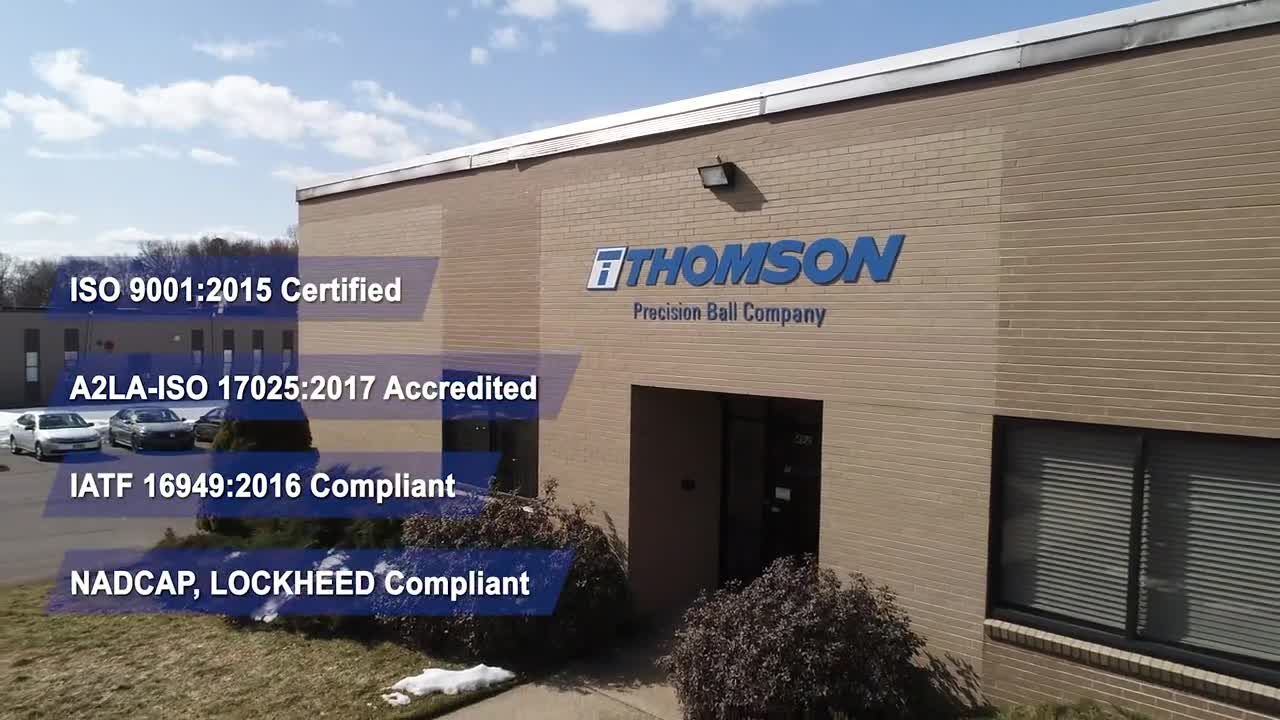
- Registered to ISO 9001:2015
- Accredited Lab to ISO 17025 by A2LA, for measurement of size, sphericity, and surface finish
- Statistical uncertainty of 0.000066”, 3rd party verified
Manufacturing Capabilities
- Since 1946, our US based manufacturing facility has been specializing in producing a variety of unique sizes
- We globally source our materials to meet any customer specifications including DFARS
- Our Kanban inventory, lean manufacturing, and flexibility reduces our lead time to meet your demands
Holding ourselves to the higher standard:
- Our 52100 series fully meets AMS 6440
- Our 440C Stainless Steel fully meets AMS 5630 and AMS 2700
- We provide raw material certs and a Certificate of Conformance with all shipments at no charge
NEWS:- You Should Know-
440C DFARS Readily Available- 1/16”, 3/32”, 1/8”, 5/32”, 3/16”, 1/4”, 5/16”, 11/32”, 3/8”
Meets DFARS 7009/7014, AMS 5880, AMS 5630, QQ-S-763, ASTM A276, AMS 2759, ASTM F2215, HRC 58-62, AMS 2700, NADCAP Heat Treat
NADCAP Passivation, Retained Austenite Available
Thomson Precision Ball Co. Overview
Step inside Thomson Precision Ball Company and see how its ISO 9001:2015-certified facility, A2LA-accredited laboratory and experienced employees have helped it become a trusted precision ball manufacturer for 75 years and counting.